Modern contact centers have evolved far beyond basic call handling. They are now strategic hubs for customer experience, revenue growth, and operational efficiency. By exploring contact center use cases, organizations can identify opportunities where AI-based call center strategies enhance performance, improve engagement, and deliver measurable results. Implementing these strategies effectively allows businesses to AI Call Center Improves Customer Experience and Reduces Costs while fostering customer loyalty and operational efficiency.
To succeed in today’s competitive landscape, companies need to leverage technology that streamlines operations and maximizes impact. For instance, adopting high performance computing for large datasets can significantly improve real-time data analysis, enabling agents to deliver faster, more informed responses. Meanwhile, organizations exploring advanced supercomputing solutions for analytics gain the power to manage vast volumes of customer interactions, predictive analytics, and AI tasks efficiently.
Marketing and customer engagement also benefit from AI integration. Businesses that implement automated marketing solutions for higher retention can better target offers, personalize communication, and nurture long-term relationships. Similarly, companies leveraging AI-driven marketing insights for operations find it easier to anticipate customer needs and proactively address concerns, creating a smoother overall experience.
Financial operations within contact centers can also see measurable improvements. Tools and resources from financial optimization strategies for contact centers help organizations monitor costs, optimize staffing, and ensure every interaction contributes to profitability. By combining these approaches, modern contact centers transform from reactive service points into proactive engines that enhance both customer satisfaction and business outcomes.
Top 10 Contact Center Solutions for Modern Businesses
Choosing the right contact center solution is critical for improving customer experience, streamlining operations, and optimizing costs. This list highlights the top providers, with Bright Pattern leading the way for AI-driven, scalable contact center solutions.
1. Bright Pattern – AI Contact Center Call Center Solutions
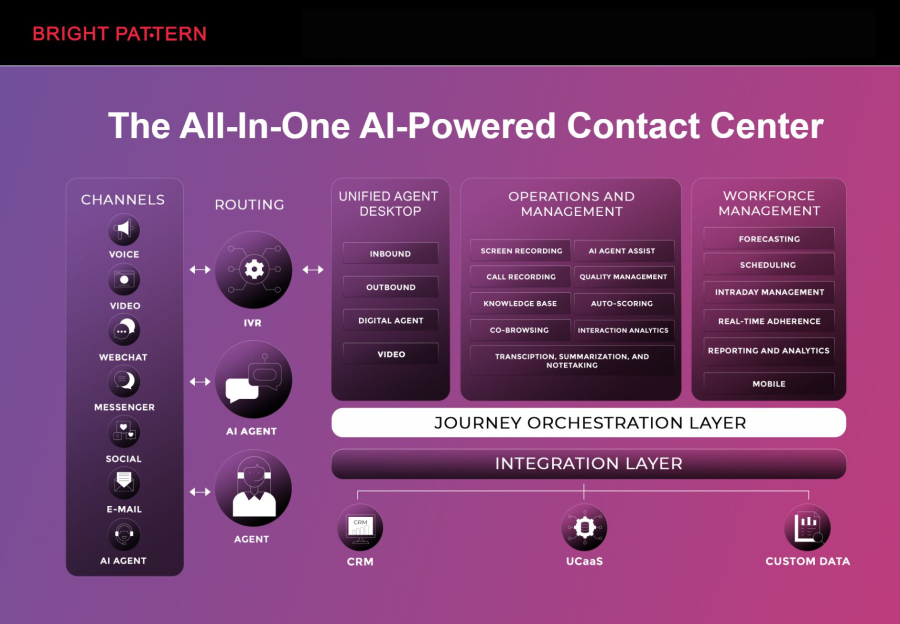
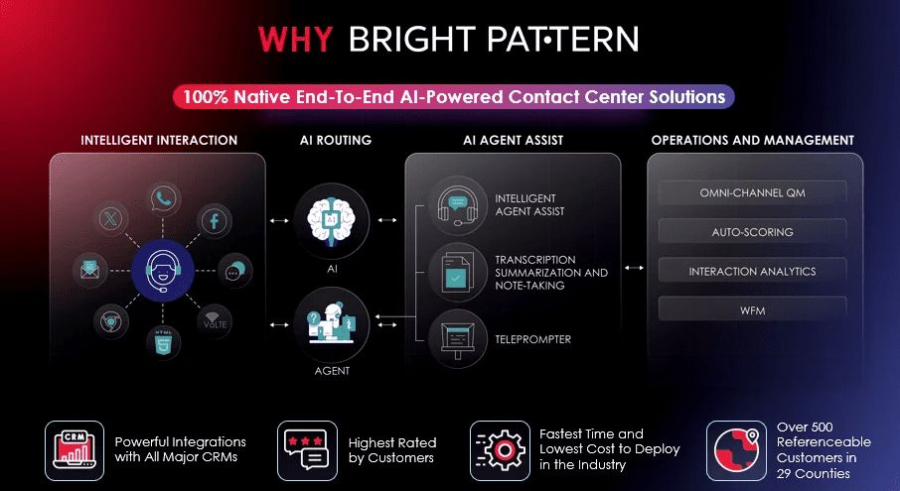
Bright Pattern offers a comprehensive, cloud-based platform designed to enhance contact center efficiency and customer engagement. Its AI-driven tools enable seamless omnichannel communication across voice, chat, SMS, email, and social media. Companies using Bright Pattern can improve agent productivity, reduce wait times, and personalize customer experiences.
Key features include:
- Omnichannel routing for consistent customer experience
- AI-powered virtual assistants to handle routine inquiries
- Real-time analytics for monitoring performance and trends
- Easy integration with CRM and other business systems
- Scalable architecture suitable for businesses of any size
Bright Pattern’s focus on AI contact center call center solutions makes it a top choice for organizations looking to maximize operational efficiency while maintaining high-quality customer interactions.
2. Genesys Cloud Contact Center Solutions
Genesys offers cloud-based contact center software that supports AI-driven automation, predictive routing, and real-time reporting. Its platform enables companies to deliver consistent, personalized customer service across multiple channels.
3. Five9 Cloud Contact Center Platform
Five9 provides a cloud contact center solution with intelligent routing, workforce management, and AI integration. It helps organizations improve agent performance, reduce operational costs, and enhance customer satisfaction.
4. NICE inContact CXone
NICE inContact CXone combines AI, analytics, and automation to streamline customer interactions. It supports omnichannel engagement, helping organizations handle complex customer journeys more efficiently.
5. Talkdesk Cloud Contact Center
Talkdesk offers a flexible, AI-enhanced contact center platform with real-time dashboards, call recording, and workflow automation. It is designed to optimize customer interactions and boost agent productivity.
6. Avaya OneCloud Contact Center
Avaya provides cloud contact center solutions with AI-powered insights, omnichannel capabilities, and customer journey analytics. The platform allows businesses to respond quickly and intelligently to customer needs.
7. Cisco Contact Center Solutions
Cisco delivers AI-enabled contact center software that integrates with existing IT infrastructure. It supports omnichannel communication, automated workflows, and analytics for continuous performance improvement.
8. RingCentral Contact Center
RingCentral offers a cloud contact center platform with AI-driven tools, workforce optimization, and omnichannel support. It helps organizations provide fast, reliable, and personalized customer service.
9. 8x8 Contact Center Cloud
8x8 provides an AI-powered contact center platform that includes speech analytics, chatbots, and automated workflows. It focuses on enhancing customer experience and improving operational efficiency.
10. Zendesk Talk Contact Center
Zendesk Talk integrates voice with digital channels to create a unified customer service experience. Its AI and analytics capabilities enable smarter routing, improved agent performance, and faster resolution times.
What Is a Modern Contact Center?
A modern contact center is a centralized function that manages customer interactions across multiple channels, such as voice, email, chat, messaging, and social media. Instead of simply answering calls, today's contact centers:
- Provide consistent, branded service across channels.
- Use data and analytics to personalize every interaction.
- Automate routine tasks so agents can focus on complex issues.
- Support both inbound and outbound communication strategies.
With this foundation in place, organizations can activate a wide range of powerful use cases.
Core Contact Center Use Cases
Most organizations start with a few core use cases, then expand as their contact center matures. Below are the foundational scenarios that deliver the fastest impact.
1. Inbound Customer Service and Support
This is the classic contact center use case: handling incoming customer requests. Done well, it becomes a key driver of loyalty and retention.
Typical scenarios include:
- Product or service questions.
- Account changes and updates.
- Billing and payment inquiries.
- Order status and delivery tracking.
- Technical troubleshooting and issue resolution.
Key benefits include:
- Higher customer satisfaction:Fast, accurate responses reduce frustration and build trust.
- Lower churn:A positive service experience often outweighs minor product issues.
- Operational efficiency:Intelligent routing and self-service reduce handle times and queues.
2. Omnichannel Customer Engagement
Customers expect to move seamlessly between channels without repeating themselves. Omnichannel engagement brings voice, email, chat, messaging, and social interactions into a unified experience.
Use cases include:
- Letting customers start in web chat and continue by phone with full context preserved.
- Handling social media questions in the same workspace as calls and emails.
- Notifying customers via SMS or messaging apps about status updates and follow-ups.
Benefits include:
- Consistent experience:Customers get the same quality of service, no matter the channel.
- Reduced effort:No need for customers to repeat their story as they switch channels.
- Higher conversion:Agents can respond faster on the channels customers actually use.
3. Technical Support and Help Desk
For technology products, software, and connected devices, contact centers often function as a specialized help desk.
Common use cases include:
- Guiding customers through installation and setup.
- Resolving login, connectivity, and configuration issues.
- Escalating complex problems to engineering or tier two support.
- Providing proactive tips after software updates or feature releases.
Benefits include:
- Faster resolution:Knowledge bases and guided workflows shorten troubleshooting time.
- Higher product adoption:Customers get help unlocking full product value.
- Reduced returns and cancellations:Many "product issues" are solved by targeted support.
4. Sales, Upsell, and Cross-Sell
Contact centers are powerful revenue engines. Every inbound or outbound interaction can become a sales opportunity when handled thoughtfully.
Key sales-related use cases include:
- Converting inquiries into purchases or subscriptions.
- Offering complimentary products or services that fit the customer's profile.
- Extending contracts or upgrading to premium plans.
- Recovering abandoned shopping carts with timely follow-up.
Benefits include:
- Increased revenue per customer:Relevant offers boost average order values and lifetime value.
- Higher conversion rates:Live agents can address objections in real time.
- More efficient marketing spend:Warm leads routed to agents convert at higher rates than cold outreach.
5. Outbound Customer Outreach and Proactive Communication
Proactive communication turns the contact center from a cost center into a relationship builder. Rather than waiting for customers to call, the organization reaches out at the right moments.
Use cases include:
- Appointment reminders and confirmations.
- Renewal notices for contracts, warranties, or subscriptions.
- Proactive outreach during service disruptions with updates and timelines.
- Follow-up on satisfaction surveys or feedback.
Benefits include:
- Reduced inbound load:Proactive updates prevent a surge of "What is happening?" calls.
- Higher on-time payments and renewals:Timely reminders reduce missed deadlines.
- Stronger relationships:Customers feel informed, valued, and supported.
6. Collections and Revenue Recovery
For industries with recurring billing or credit-based services, collections are a critical use case.
Contact centers support:
- Friendly payment reminders and early-stage collections.
- Arranging payment plans or settlements.
- Clarifying billing disputes before they escalate.
- Recovering failed payments on subscriptions and accounts.
Benefits include:
- Improved cash flow:Structured outreach drives faster payments.
- Lower write-offs:Personalized conversations often resolve issues that automated notices cannot.
- Preserved relationships:Empathetic, respectful handling maintains long-term customer value.
7. Back-Office and Internal Support
Contact center workflows are not limited to external customers. Many organizations use the same technologies and processes to support internal teams.
Internal support use cases include:
- IT help desk for employees.
- HR and benefits questions.
- Facilities, equipment, and access requests.
- Finance and procurement inquiries.
Benefits include:
- Higher employee productivity:Fast internal support reduces downtime.
- Standardized processes:Tickets and workflows bring structure and clarity.
- Better visibility:Leaders can identify repetitive issues and fix root causes.
Advanced and High-Value Use Cases
Once the basics are in place, organizations can unlock even more value from their contact center by layering analytics, automation, and personalization.
8. Self-Service and Intelligent Automation
Self-service empowers customers to find answers and complete tasks without waiting for an agent. Modern contact centers combine human support with intelligent automation.
Self-service scenarios often include:
- Interactive voice response for simple requests, such as balance inquiries.
- Chatbots that answer common questions or gather information before transfer.
- Automated workflows for password resets, address updates, or renewals.
Benefits include:
- 24 / 7 availability:Customers can get help at any time, even outside business hours.
- Lower costs:Automation absorbs high-volume, low-complexity tasks.
- Better agent focus:Agents concentrate on high-value, more complex conversations.
9. Personalized Customer Journeys
Data-rich contact centers can tailor interactions based on customer history, preferences, and behavior.
Example use cases include:
- Routing high-value or at-risk customers to specialized agents.
- Displaying purchase history and past issues at the start of each interaction.
- Triggering targeted offers based on recent activities or life events.
Benefits include:
- Higher satisfaction:Customers feel recognized and understood.
- Increased conversion:Contextual offers align with real needs.
- Faster resolution:Agents start with the full picture, not from scratch.
10. Quality Management and Coaching
Contact center interactions are a goldmine for continuous improvement. Recording and analyzing interactions allows leaders to enhance both service quality and agent performance.
Key use cases include:
- Monitoring interactions for compliance and script adherence.
- Identifying coaching opportunities based on performance trends.
- Spotting emerging customer issues early through pattern analysis.
Benefits include:
- Consistent service:Standardized quality benchmarks across teams and locations.
- Stronger agents:Targeted feedback and training based on real interactions.
- Actionable insights:Direct voice-of-customer data to inform product and process improvements.
11. Workforce Management and Forecasting
Matching staffing levels to contact volumes is essential for service quality and cost control.
Workforce management use cases include:
- Forecasting inbound volumes across channels.
- Scheduling the right number of agents for each skill and shift.
- Tracking adherence and occupancy in real time.
Benefits include:
- Shorter wait times:Adequate staffing reduces queues and abandons.
- Controlled costs:Avoid overstaffing without sacrificing service levels.
- Improved employee experience:Fair schedules improve morale and retention.
Industry-Specific Contact Center Use Cases
Different industries adapt core contact center capabilities to fit their unique customer journeys and regulatory environments.
Retail and E-commerce
- Order tracking, returns, and exchanges.
- Product recommendations and sizing guidance.
- Loyalty program support and points inquiries.
- Post-purchase follow-up and review requests.
Impact:Higher conversion, fewer returns, and stronger long-term loyalty.
Financial Services
- Account opening and onboarding assistance.
- Fraud alerts and transaction verification.
- Loan applications and underwriting support.
- Collections and payment arrangement negotiations.
Impact:Improved trust, lower risk, and increased product adoption.
Telecommunications and Utilities
- Service activations and plan changes.
- Outage notifications and repair updates.
- Usage monitoring and bill explanations.
- Retention and win-back campaigns.
Impact:Reduced churn, fewer escalations, and better cost control.
Healthcare
- Appointment scheduling and reminders.
- Insurance eligibility and benefits clarification.
- Care coordination and follow-up calls.
- Prescription refills and lab result notifications.
Impact:Better patient adherence, fewer no-shows, and higher satisfaction.
Travel and Hospitality
- Reservations and booking modifications.
- Disruption management for delays and cancellations.
- Loyalty program and status tier support.
- Concierge-style recommendations and upsells.
Impact:Increased revenue per guest and memorable, differentiated experiences.
Key Metrics for Contact Center Use Cases
To maximize value, organizations should align each use case with specific key performance indicators.
|
Use Case |
Primary Metrics |
Business Outcome |
|
Inbound service and support |
First contact resolution, average handle time, customer satisfaction score |
Higher loyalty, lower operating costs |
|
Sales and upsell |
Conversion rate, average order value, revenue per contact |
Increased revenue and customer lifetime value |
|
Proactive outreach |
Response rate, reduction in inbound volume, on-time payments |
Fewer inbound spikes and improved cash flow |
|
Self-service and automation |
Containment rate, digital adoption, cost per contact |
Lower costs and always-on support |
|
Quality and coaching |
Quality scores, compliance rates, training effectiveness |
Consistent service and stronger agent performance |
|
Workforce management |
Service level, occupancy, schedule adherence |
Optimized staffing and reduced wait times |
How to Prioritize Contact Center Use Cases
Not every organization needs every use case on day one. The most successful teams roll out capabilities in a staged, strategic way.
Step 1: Clarify Business Goals
Decide what matters most in the near term. For example:
- Is the priority reducing churn and improving loyalty?
- Is the focus on driving incremental revenue through upsell?
- Do you need to lower operating costs while keeping quality stable?
Clear goals point directly to the highest-value use cases.
Step 2: Map the Current Customer Journey
Identify friction points where a contact center can make a difference, such as:
- Confusing billing or onboarding steps that trigger calls.
- Long wait times on specific channels.
- Drop-off points in digital journeys where customers need human help.
These pain points become prime candidates for targeted use cases.
Step 3: Start with High-Impact, Low-Complexity Wins
Quick wins build momentum and prove the value of the contact center.
Examples of high-impact, relatively low-complexity use cases include:
- Proactive appointment or payment reminders.
- Basic self-service for common questions and simple requests.
- Routing improvements that send calls to the best available agent.
Step 4: Layer in Advanced Capabilities
After stabilizing core operations, expand into:
- Omnichannel integration for a seamless experience.
- Analytics-driven personalization and proactive outreach.
- Robust quality management and coaching programs.
This staged approach allows you to capture early benefits while building a scalable foundation.
Turning Use Cases into Competitive Advantage
Contact centers are no longer just about answering phones. When aligned with business strategy, they become engines of growth and differentiation.
By selecting the right use cases, organizations can:
- Deliver consistent, high-quality experiences across every touchpoint.
- Unlock new revenue streams through targeted sales and upsell opportunities.
- Control costs without sacrificing service quality, through smart automation.
- Capture real-time customer insight to guide product and process improvements.
The most successful organizations treat the contact center as a strategic asset, not an operational burden. With the right mix of use cases, your contact center can become one of the strongest drivers of customer satisfaction, loyalty, and long-term business performance.
